Announcement

Collapse
No announcement yet.

{The List-} Movement, supply, etc.

Collapse
X
 
  • Filter
  • Time
  • Show
Clear All
new posts

  • Sorry to interfere again, frekk. No steam engines this time, I promise.

    The problem with Civ3, as I see it, is not the unlimited movement rails give. It's perfectly ok with me, as long as borders don't move. Peace-time infrastructure can handle large troop movements at ease. What bothers me is, that a player can take (very few) Workers and put rails nearly anywhere while battles occur. So, instead of a strategic importance, reailroad becoms a tactical utility for the player. That's something that really bothers me in the current model.

    And an easy way to handle it, is to forbid building rails on the same turn the border moved (in tiles that didn't belong to you at the very beginning of the turn). In addition, require foreign rails to be transformed, because of the differences in carriage and engine models (Germans had that problems during WWII... Oh, shdt, I'm onto steam engines again ). Basically, your units would have to treat all conquered territiry as roaded at most, for the first turn you own it. How's that for halting a rails+cavalry blitz?
    Seriously. Kung freaking fu.

    Comment


    • Originally posted by Modo44
      What bothers me is, that a player can take (very few) Workers and put rails nearly anywhere while battles occur.
      Oh geez, they did that all the time ... they'd build rails right up as far as they could. If they were in strength in the area, anyway.
      Railroad Capacity - Version 2

      Comment


      • Originally posted by Modo44
        Basically, your units would have to treat all conquered territiry as roaded at most, for the first turn you own it. How's that for halting a rails+cavalry blitz?
        ++ That's a great idea. Or to take it one step futher, it's always bothered me how artillary/bombing can cause so much damage to a rail that it costs as much to fix it as it did to lay the rail in the first place. How's about a "damaged" state for rails that makes the rails unusable, but requires significantly less work to repair than rebuilding the whole rail line.

        Thus an artillary barrage could "damage" but not destroy a whole tile worth of rail. Then any rail in captured territory is automatically captured "damaged", and must be repair by workers before you can proceed.

        This would also make workers tactically important, as you'd have to have a few of them on the front line to repair RR as you go.

        Comment


        • I wrote that in the "Terrain and improvement" List thread, but it sadly seems to be a common juridiction to both threads. So anyway, here's what i wrote:

          There isn't a point to have railroads all over the place in the real world. What we call "railroad" in civ is in fact advanced movement infrastructure in the real world. THIS is something we put all over the country. Puting railroads everywhere costs more, while in ORDINARY situations, only those between two cities are used. More is just a waste of money.

          To have this, one would need to get "railroad" separated from "advanced roads/highways". With a cost to infrastructure and economic advantages (trade...) to get cities connected, everything seems globally solved. As simple as Firaxis' Civ... perhaps.
          Go GalCiv, go! Go Society, go!

          Comment


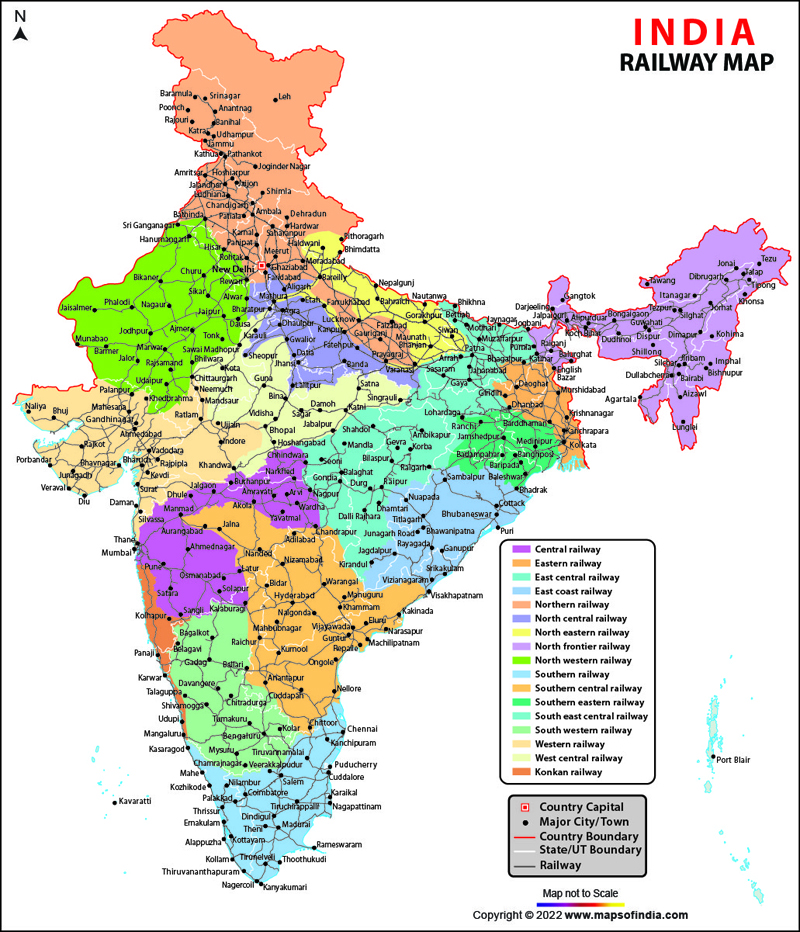
          • Well, actually, rails do pretty much exist in a network, not as lines between cities (that would be highways). This is because there are trunk lines, and then there is finer network of branch lines, which often go to things like mines or grain elevators, not just cities.

            Here is a great interactive map to show an example:

            Map of Indian railways showing the rail network across the country with different railway zones like central, eastern, northern, north eastern, north east frontier, southern, south central, south eastern, western and Konkan railway illustrated on the map. Just click on your state to find out your state railway map.


            The map shows the major lines but you can click on it and see that within each province, there is a smaller network of minor lines.
            Railroad Capacity - Version 2

            Comment


            • Still, the main points of the network are cities, right? So how about this simple idea: unlimited movement via rails, but only from city to city. In other places rails give a speed bonus, but not unlimited movement. So if you move from point A to point B, you have to use movement points to get to a city near A, and then to get from a city near B to the point B. In addition, of course some restrictions on using rails in newly conquered territory, like no unlimited movement due to damaged infrastructure.

              Yes, I'm still convinced there's no real way of halting railroad sprawl, if the game has any realistic rail model, once human players get their hands on it. So I just give up fighting it directly, and try to figure out ways to make those rails less attractive, while retaining a somewhat realistic model.
              Seriously. Kung freaking fu.

              Comment


              • instead of unlimited move on rail , only make it like 10 hexes ...
                GM of MAFIA #40 ,#41, #43, #45,#47,#49-#51,#53-#58,#61,#68,#70, #71

                Comment


                • Originally posted by frekk
                  Originally posted by Straybow
                  Pocket kingdoms are irrelevant.

                  Why? Games are played across an entire range of scales. Official maps included with the game include the eastern Meditteranean, in which Serbia would be an average civ. This is a totally false argument based on a subjective experience of the game. YOU prefer whole earth maps; this means nothing.

                  Changing the scale of the map changes the scale of the units, too. If they are no longer division-sized they need far less resources to move and draw supplies. If Serbia is average then Montenegro (or Lichtenstein, Andorra etc) is a pocket kingdom.

                  This is given as evidence that interdicting supply is pointless because supply consumes a small fraction of capacity compared to unit movement.

                  Again, from the Rand study: "Mobility denial, rather than supply denial, had been the key to the Allied success [in Italy]." That is tactical, not strategic.

                  Incorrect, because you have misunderstood the premise of the article by failing to read it in context. The units were denied strategic redeployment mobility not tactical mobility [blah, blah]

                  I read the whole thing, not just what you quoted.

                  I'll give you a hint: "Operation Strangle" was also known as the "Rail Interdiction Program". These were not tactical attacks on units, no matter how you might try to twist it to seem so. It had nothing to do with tactical attacks on units whatsoever. Just do a google for "operation strangle" and you'll see what I mean quite quickly. I'd really like to see you explain how a campaign officially known as the "Rail Interdiction Program" is tactical, not strategic.

                  Except that the scale of action was neither clearly tactical nor strategic (as one Russian general coined it, "operational" scale). The mountainous terrain prevented movement of units except on rails and roads, and the roads couldn't handle the traffic. The time scale was short, days rather than months or years. That makes it more tactical than strategic.

                  ²interdict ...3 : to destroy, damage, or cut off (as an enemy line of supply) by firepower to stop or hamper an enemy

                  In Civ attacking a unit may well be attacking the supplies and interdicting movement on the battlefield. Whatever diminishes the unit as a fighting force is an attack at the strategic scale of the Civ game.

                  It says nothing about congestion or local shortages; this is your own invention. It says "LACK OF ROLLING STOCK". It cannot be any clearer. There was not sufficient rolling stock for all of these activities to take place at the same time. In other words, the capacity was limited.

                  I think you are the one who needs to re-read the whole article, especially the section I quoted. The potential lack of national rolling stock is caused by demand at particular locations at particular times. It is not a network-wide problem.

                  [snip a bit] but in the case of the Low Countries where national stocks are limited there could be problems getting stocks from France.

                  My emphasis [on "national stocks are limited"], I need say no more.

                  No, you do need to explain how limits on national stocks of tiny countries (you neglected to emphasize or did not understand that it is the Low Countries where the problems arise) in a large alliance apply to rolling stocks of large empires without such artificial territorial stock divisions. Oh, it doesn't? Next point.

                  Road capacity is usually given as the reason for stacking limits in the grognard cardboard chit and paper map wargames. Footnote 12 implies that rail capacity is up to 20 times higher than road capacity.

                  Literally hundreds of those games implement rail capacity rules. [blah, blah, blah]

                  None of which are on the scale of Civ in time, distance, or unit sizes. A few are large scale geographically, but far shorter turn lengths (weeks instead of years). I know of one global scale game with 3-month turn length; it has even more generalization of transport than Civ.

                  Micromanagement is where you're forced to repetitively manage something, like picking which tiles to build rail in based on production factors or something. Rail capacity doesn't need to be done that way. It can be made automatic. What management do you need to do if rail capacity is just so many points depending on tech? It's not even possible to manage it in such a simple system. It just is.

                  So the size of the network (distances, number of cities, tile and city improvements built) will have no effect? Whether you move one unit a short distance or a long distance will have no effect? Any time you have limited resources you have to manage them. If, for example, moving one unit N tiles gives a different result from moving N+1 tiles, then you will have micro-management.

                  Why do I want to introduce rail capacity as a limitation? Several reasons, chiefly being to introduce some strategy to the positioning of forces and to represent logistical limitations. Currently there is none. It's biggest empire wins because they can just rail a tide of forces to the front without worrying about logistics or supply whatsoever. Territory = victory, *always*. It doesn't make for a very challenging game. In human play it comes down to the blind luck of starting position. In play vs the AI you can give the AI increasing amounts of starting advantages and the only real challenge is surviving the advantages long enough to get rails. Once you get rails, you basically win.

                  That's funny, I've won plenty of games long before rails. You can't do what you've claimed just by discovering RR. No, you have to invest hundreds of unit-turns building this vaunted rail network of limitless attack. If you are playing MP you'd find out that a human opponent doesn't sit on his hands waiting for you to finish all that construction...

                  And at no other point in the game is there any consideration of supply, with units wandering for centuries away from home. It still costs a shield to support the unit even though there's no way anything could be shipped to where the unit is located.

                  What I want to know, is why are you so irrationally opposed to a rule that's a common feature of many, many other games? It's not like you couldn't set capacity to unlimited in the editor if it turned out you didn't like it.

                  None of those games are Civ. There are ways to make supply limitations without micromanagement. What you propose isn't one of them.
                  (\__/) Save a bunny, eat more Smurf!
                  (='.'=) Sponsored by the National Smurfmeat Council
                  (")_(") Smurf, the original blue meat! © 1999, patent pending, ® and ™ (except that "Smurf" bit)

                  Comment


                  • Originally posted by Straybow
                    Changing the scale of the map changes the scale of the units, too. If they are no longer division-sized they need far less resources to move and draw supplies. If Serbia is average then Montenegro (or Lichtenstein, Andorra etc) is a pocket kingdom.
                    So what does that have to do with anything? The fact remains that Serbia is probably an average sized civ on an Average (80 x 80?) map. 100% rail capacity was destroyed.

                    Except that the scale of action was neither clearly tactical nor strategic (as one Russian general coined it, "operational" scale). The mountainous terrain prevented movement of units except on rails and roads, and the roads couldn't handle the traffic. The time scale was short, days rather than months or years. That makes it more tactical than strategic.

                    ²interdict ...3 : to destroy, damage, or cut off (as an enemy line of supply) by firepower to stop or hamper an enemy
                    Aerial interdiction is always considered to be a "strategic attack". It is never considered to be tactical, regardless of what level it occurs at.

                    The time scale was not, in fact, in days, but at least weeks if not months: Operation Strangle lasted from late winter (Febuary) to early summer (June) of '44.

                    Further, Operation Strangle failed precisely because it did not degrade the combat ability of units in the area, it merely prevented their movement. Not much capacity was required to deliver minimal supplies, and no ground offensive was launched to take advantage of the fact that additional units could not be brought up to hold the line.


                    The potential lack of national rolling stock is caused by demand at particular locations at particular times. It is not a network-wide problem.
                    Of course it is ... bottlenecks and breakdowns occur at specific locations, but are caused by the overall character of the national infrastructure. About half of it is organizational in nature, as is clearly evinced in the article I quoted. Besides, it is too difficult in the game to model local capacities and bottlenecks; which of course are caused by total throughput.

                    No, you do need to explain how limits on national stocks of tiny countries (you neglected to emphasize or did not understand that it is the Low Countries where the problems arise)
                    Again this is your invention: the actual article implies transfers of rolling stock between France, Britain, and the US, with no real mention of the Low Countries in this context. It only mentions their presence in reference to the length of supply lines, not in rolling stock limitations which can easily be transferred from France or Channel ports. The whole of NATO response did not depend even a bit on Dutch rolling stock. The problem came if there was an inundation of simultaneous deployments between France, USA, and Britain, as they shared rolling stock collectively and the total amount was not enough. They were expected to overcome this problem by deploying sequentially, using the combined capacity of all 3 powers in turn, as none of them had the individual capacity to deploy all their forces as rapidly as would be desired.

                    None of which are on the scale of Civ in time, distance, or unit sizes. A few are large scale geographically, but far shorter turn lengths (weeks instead of years). I know of one global scale game with 3-month turn length; it has even more generalization of transport than Civ.
                    I know of only 4 whole-world or pan-European games that Avalon Hill ever made; and all of them have rail capacity limitations.

                    Any time you have limited resources you have to manage them. If, for example, moving one unit N tiles gives a different result from moving N+1 tiles, then you will have micro-management.

                    You say this, but really, there isn't much micromanagement at all since at most you will have a small number of units to pick each turn for unlimited movement, the rest moving normally. You're mistaking micromanagement, which is repetitive tedium, for game decisions. Managing resources is not necessarily micromanagement, unless it's something that's done at a very local (rather than national) level. Micromanagement implies a certain amount of repetitive action - not mere managing of resources. The science/tax slider, for instance, is NOT micromanagement because it is so abstracted.

                    And anyway, a RC model is extremely minimal compared to making considerations for every unit on the entire board every round, which is what you appear to propose as an alternative:

                    And at no other point in the game is there any consideration of supply, with units wandering for centuries away from home. It still costs a shield to support the unit ... There are ways to make supply limitations without micromanagement. What you propose isn't one of them.
                    If "every time you have limited resources you must manage them" and this equals "micromanagement", then it rationally follows that the only supply model that isn't micromanagement is one which does not involve delivering supplies themselves but abstracts that aspect - in other words, the current system.

                    By the way, it hasn't cost shields to support units since Civ2 ...
                    Last edited by frekk; December 10, 2004, 21:35.
                    Railroad Capacity - Version 2

                    Comment


                    • So what does that have to do with anything? The fact remains that Serbia is probably an average sized civ on an Average (80 x 80?) map. 100% rail capacity was destroyed.

                      Serbia and Montenegro: 102k km² Europe: 9,938k km²
                      So an "average" civ is 1% of the land area? No, Serbia is the pathetic civ with only one city that you don't kill because you have to wait until 1500 AD so the civ won't respawn.

                      Aerial interdiction is always considered to be a "strategic attack". It is never considered to be tactical, regardless of what level it occurs at.

                      The time scale was not, in fact, in days, but at least weeks if not months: Operation Strangle lasted from late winter (Febuary) to early summer (June) of '44.

                      The nature of aerial interdiction is strategic because it is planned and conducted at the corps/army level, not because its actions are not tactical. When the attack on the same type of asset is directed at lower unit levels it is called "close air support." It is merely a convention of jargon.

                      Your response is equivalent to claiming D-Day was not stretegic because the fighting didn't take months. There is always overlap in what is tactical and what is strategic. Everything that is strategic gets implemented at the tactical level.

                      The time-scale of action in Operation Strangle is not the total time the attacks were conducted. As you said, the only way to take advantage of the interdiction would have been to order attacks while the units could not maneuver to respond in force. That requires tactical response following the air strikes, ie, combined operations conducted as close air support instead of strategic operations isolated from ground operations.

                      In other words, the brass were trying to solve a tactical problem (assaulting dug-in units in the mountains) on the strategic level and it didn't work.

                      bottlenecks and breakdowns occur at specific locations, but are caused by the overall character of the national infrastructure. About half of it is organizational in nature, as is clearly evinced in the article I quoted. Besides, it is too difficult in the game to model local capacities and bottlenecks; which of course are caused by total throughput.

                      No, the point of the article is that essentially all of the problems are organizational in nature. The division of stock into national reserves is political and unrelated to throughput. Therefore, in a polity in which no artificial localizations of stock interfere (such as CONUS, or a Civ Empire) the problem doesn't exist.

                      No, you do need to explain how limits on national stocks of tiny countries (you neglected to emphasize or did not understand that it is the Low Countries where the problems arise)

                      Again this is your invention: the actual article implies transfers of rolling stock between France, Britain, and the US, with no real mention of the Low Countries in this context. It only mentions their presence in reference to the length of supply lines, not in rolling stock limitations which can easily be transferred from France or Channel ports.

                      So it only implies transfer between the major partners but doesn't imply transfer of stock between corps commands and Low Country national stock? That's mighty selective of you. You need to learn how to research. You can't see what the article says because you are only seeing what you want to see. The article assumes the reader is familiar with the deployment area in question (eg, BOAR and the prepositioned US caches).

                      Again, from the article:
                      If the national authorities refused to transfer stocks then the Army Group Commander would have to refer the decision to the Commander-in-Chief Central Region (CINCENT) who would then negotiate with the Ministries of Defence concerned. Tactical and logistic responsibility was thus separated and command was divided.

                      In other words the problem is diplomatic, not something inherent to the rail system.

                      The whole of NATO response did not depend even a bit on Dutch rolling stock. The problem came if there was an inundation of simultaneous deployments between France, USA, and Britain, as they shared rolling stock collectively and the total amount was not enough.

                      No, NATO never had a problem with the Dutch sharing national stock in common defense, the problem is that Dutch and Belgian national stock in excess of national corps support requirements is insignificant. German stock is assumed to suffer significant attrition and interdiction, and therefore localized shortfalls can only be made up from France.

                      As quoted above the problem was that sharing stock necessitated political negotiations outside the command structure, with inevitable delays. The article also explains how each national corps had a dedicated "tramline" for support and supply. Incompatible munitions (also due to the political divisions) limit sharing of stock between the "tramlines."

                      Again, the article assumes the reader understands the political and military backdrop and does not name the problem child in the family. Thus the article concludes that the nature of the alliance (and its repercussion to rail capacity in this case) remained an "achilles' heel" for NATO.

                      I know of only 4 whole-world or pan-European games that Avalon Hill ever made; and all of them have rail capacity limitations.

                      In other words, most of the "hundreds" of games with rail capacity limitations are not comparable to Civ in scope, and therefore irrelevant. As for the large scale AH games, like Civ they are games, not simulations. We can only speculate about their game design and balance decisions absent the designers' input here.

                      The AH large scale games have territories that are national in size (or larger). This could mean rail capacity involves such things as guage changes (between Europe and Russia) and national politics. They could have rail capacity limitations as a gameplay feature to balance the turn structure, so one player can't roll over another without the defender being able to respond. Or maybe both, or neither.

                      Please do not confuse AH game play mechanisms with arguments from "realism" without something to back it up.

                      If "every time you have limited resources you must manage them" and this equals "micromanagement" [blah, blah, blah]

                      That's funny, you managed to quote me accurately, then ignored what I said to make this comment. I'll explain again, please try to keep up. I did not equate management with micromanagement. I did give a generalized example of how management becomes micromanagement because of discrete movement allowances and other factors inherent to the game. These factors necessarily relate to decision making, ie, which units use the proposed limited rail capacity.

                      Managing resources is not necessarily micromanagement, unless it's something that's done at a very local (rather than national) level. Micromanagement implies a certain amount of repetitive action - not mere managing of resources. The science/tax slider, for instance, is NOT micromanagement because it is so abstracted.

                      In Civ2 the discrete nature of the sliders causes micromanagement. Instead of sliding lux on a continuum until cities celebrate (let's say this would hypothetically occur at 22%) one must set lux at the nearest 10% increment (20% in this example) and then manipulate recalcitrant cities' workers and specialists.

                      Civ3 tried to get around this with luxuries modeled specifically, which still leads to city by city management of details to achieve happiness goals. But then both Civ2 and Civ3 play can involve micromanagement of science output by much the same way and for similar reasons.

                      And anyway, a RC model is extremely minimal compared to making considerations for every unit on the entire board every round, which is what you appear to propose as an alternative

                      When did I propose making considerations for every unit? Again, you aren't following my argument. It is that supply isn't modeled at all, it is abstracted. Supply is an infrastructure issue much the same as "rail capacity." We don't worry about how units get their supplies (whether in Civ2 where units are supported by shields, or Civ3 which I tried so long ago I don't remember how units are supported). We don't worry about how the rail system keeps stock distributed.

                      I brought up supply (which is not the same as support, but should be familiar to a tabletop wargame player) because a simple map and ZOC based supply model can solve many of the unlimited rail problems people (including you) complain about. Other problems are inherent to the turn structure and can't be mitigated by rail capacity limits.

                      Your method, on the other hand, requires that each unit's objectives and intrinsic movement allowance be weighed against the limited rail capacity instead of just moving the units that have access to rail by rail and not worrying about capacity. That can easily become micromanagement.
                      (\__/) Save a bunny, eat more Smurf!
                      (='.'=) Sponsored by the National Smurfmeat Council
                      (")_(") Smurf, the original blue meat! © 1999, patent pending, ® and ™ (except that "Smurf" bit)

                      Comment


                      • The nature of aerial interdiction is strategic because it is planned and conducted at the corps/army level, not because its actions are not tactical. When the attack on the same type of asset is directed at lower unit levels it is called "close air support." It is merely a convention of jargon.
                        No, it isn't. There are also tactical aerial attacks, what you call "close air support", and they don't involve blowing up railway stations, but directly attacking troops and their supply depots. It means just what it says, close air support. Strategic attacks are all attacks which do not directly impact on enemy units.

                        As you said, the only way to take advantage of the interdiction would have been to order attacks while the units could not maneuver to respond in force. That requires tactical response following the air strikes, ie, combined operations conducted as close air support instead of strategic operations isolated from ground operations.
                        Any strategic attack must be combined with tactical efforts in order to be effective. This doesn't mean it is no longer a strategic attack. Believe me, if they had sent soldiers in to attack the line they wouldn't have called the bombing of railway station behind the lines "close air support!" "Distant" air support perhaps --- in other words, strategic bombing.

                        In other words, the brass were trying to solve a tactical problem (assaulting dug-in units in the mountains) on the strategic level and it didn't work.
                        They weren't trying to assault the units. They were trying to stop more units from coming in, which is not a tactical problem but a strategic problem. It did what it was supposed to do, perfectly. The failure was on the part of command to coordinate actions to take advantage of the situation.

                        No, the point of the article is that essentially all of the problems are organizational in nature. The division of stock into national reserves is political and unrelated to throughput. Therefore, in a polity in which no artificial localizations of stock interfere (such as CONUS, or a Civ Empire) the problem doesn't exist.
                        Sure it does. Just because it is organizational doesn't mean it doesn't exist. And in any case, the problem wasn't organizational per se ... nobody had enough rolling stock. The solution was organizational - to share rolling stock and deploy consecutively rather than simultaneously. Consecutive deployment could only be represented by ... a limitation on throughput, even if you treated the alliance as a single Civ.

                        In other words, most of the "hundreds" of games with rail capacity limitations are not comparable to Civ in scope, and therefore irrelevant.
                        Correct, but we weren't talking about them. We were talking about 100% of the large scale AH games.

                        As for the large scale AH games, like Civ they are games, not simulations. We can only speculate about their game design and balance decisions absent the designers' input here.

                        The AH large scale games have territories that are national in size (or larger). This could mean rail capacity involves such things as guage changes (between Europe and Russia) and national politics. They could have rail capacity limitations as a gameplay feature to balance the turn structure, so one player can't roll over another without the defender being able to respond. Or maybe both, or neither.

                        Please do not confuse AH game play mechanisms with arguments from "realism" without something to back it up.

                        Civ is a game too, in case you hadn't noticed. As a "simulation" it is hardly more complex than, say, AH's Third Reich (which includes a fairly large theater and rail capacity, I might add). And it so happens there ARE gameplay issues - ALOT of people do not like unlimited capacity and movement on the rails! Mostly, they get confused about the nature of rail transit and assume it should have limited movement, which you and I know is wrong. If limitations are to be introduced - I'd prefer it to be capacity, not distance. If there is a limit on rail deployment in the real world - it is more true to speak of capacity than speed. Whether it is because of organizational matters, gauge structures, politics, or whatever, the fact is that there are limitations and as time goes by, these limitations tend to decrease. It's far more realistic than limited movement.

                        That's funny, you managed to quote me accurately, then ignored what I said to make this comment. I'll explain again, please try to keep up. I did not equate management with micromanagement. I did give a generalized example of how management becomes micromanagement because of discrete movement allowances and other factors inherent to the game. These factors necessarily relate to decision making, ie, which units use the proposed limited rail capacity.
                        I'm presuming you're a tabletop gamer here, so I feel safe calling your bluff ... you and I both know strategic movement rules are not overly difficult or MM heavy.

                        When did I propose making considerations for every unit? Again, you aren't following my argument. It is that supply isn't modeled at all, it is abstracted. Supply is an infrastructure issue much the same as "rail capacity." We don't worry about how units get their supplies (whether in Civ2 where units are supported by shields, or Civ3 which I tried so long ago I don't remember how units are supported). We don't worry about how the rail system keeps stock distributed.

                        I brought up supply (which is not the same as support, but should be familiar to a tabletop wargame player) because a simple map and ZOC based supply model can solve many of the unlimited rail problems people (including you) complain about. Other problems are inherent to the turn structure and can't be mitigated by rail capacity limits.
                        As we've already discussed, supply is a minimal consideration compared to deployment in the real world. And even with a shaded supply zone style ... you are still going to have to reference this every time you move a unit, not to mention considering the effects of what will occur if the edge of the zone changes.

                        Your method, on the other hand, requires that each unit's objectives and intrinsic movement allowance be weighed against the limited rail capacity instead of just moving the units that have access to rail by rail and not worrying about capacity. That can easily become micromanagement.
                        Only however many units you intend to move by rail. You'd move them, and then move your remaining units without worrying about rail. So if you had, say, 5 rail cap in the Civil War era, you'd only have to consider 5 choices. You'd look around, pick your 5, move them, and carry on with your turn. Maybe you'd move 4 and save 1 point to see how things went. In neither case would you be worrying much about it as you moved the remainder of your units.

                        Ideally rail capacity would be geared to the average number of units you might produce in a round for that time ... and then rail capacity would be enough to move all these, and a few more. Allowing you to always move all reinforcements to the front, and even shift some other stuff around ... the only thing it would prevent is what people complain most about in game balance, and that is simultaneously deploying the entirety of your forces to one area. If you weren't doing this, capacity would not be a concern in the course of things, under an ideal scale.

                        Essentially, I'm not arguing that the current system is necessarily unrealistic. Let me elaborate. Alot of people, for gameplay reasons, don't like the current system. Some of them think it's unrealistic and I, like you, would dispute that, but it is more difficult to dispute gameplay concerns, as that is a subjective opinion and can only be judged by the number of people that feel that way.

                        As an alternative, they have been proposing limited movement.

                        For a number of reasons - realism included, but also considerations in the game - I feel capacity would be a better choice IF rail is to be changed.

                        As an example of purely in-game consideration against limited movement, consider how it would be displayed in a turn. Would units be shown moving along the rail at all? If not, it would be very confusing - you'd see units all over the board in your empire with no idea where they were going or coming from. If they were displayed, would they be shown moving one square at a time along the track? This would take an exorbitantly high amount of time in the modern era - as workers are currently displayed this way when automated, you can automate 50 workers and see how long it takes. Its very dull. The last option is to show them moving along the track by displaying departure area and then destination area ... this would be alot of flicking screens, enough to induce a severe headache.

                        So, in short, I'm not arguing against the current system - merely proposing an alternative that I feel would be more realistic and easier in play than a limited movement system.

                        I've always voted for the current system in polls.
                        Railroad Capacity - Version 2

                        Comment


                        • Originally posted by frekk
                          When the attack on the same type of asset is directed at lower unit levels it is called "close air support." It is merely a convention of jargon.

                          No, it isn't. There are also tactical aerial attacks, what you call "close air support", and they don't involve blowing up railway stations, but directly attacking troops and their supply depots. It means just what it says, close air support. Strategic attacks are all attacks which do not directly impact on enemy units.

                          So, if the air force bombs a railyard, junction, or bridge and a train carrying troops or tanks happens to be there it suddenly becomes a tactical strike? Bombing a fortress or troop concentration well behind lines and far out of range of any possible ground attack isn't strategic? Or if the high altitude bombing of a bridge happens to be 100 yards from a friendly unit on the riverbank it can't be considered a strategic attack?

                          No, strategic vs tactical is contextual and generally divided by command. If it is directed from the field it is tactical, if directed from the rear on fixed assets it is generally considered strategic. As always there is overlap.

                          In other words, the brass were trying to solve a tactical problem (assaulting dug-in units in the mountains) on the strategic level and it didn't work.

                          They weren't trying to assault the units. They were trying to stop more units from coming in, which is not a tactical problem but a strategic problem. It did what it was supposed to do, perfectly. The failure was on the part of command to coordinate actions to take advantage of the situation.

                          That's funny, the article stated that the operation failed to starve the units of supplies. If that wasn't an objective, why mention it at all? No, clearly the brass were hoping to reduce the units through strategic action to lessen the burden of assault.

                          The division of stock into national reserves is political and unrelated to throughput. Therefore, in a polity in which no artificial localizations of stock interfere (such as CONUS, or a Civ Empire) the problem doesn't exist.

                          Sure it does. Just because it is organizational doesn't mean it doesn't exist. And in any case, the problem wasn't organizational per se ... nobody had enough rolling stock. The solution was organizational - to share rolling stock and deploy consecutively rather than simultaneously. Consecutive deployment could only be represented by ... a limitation on throughput, even if you treated the alliance as a single Civ.

                          True, the Dutch don't have enough stock to move everybody else's units around. Nor do the French alone, nor the Germans alone, nor British stock in ConEur, etc. But that is stock shared among political allies, not one political entity with a single pool of stock.

                          That NATO analysis has nothing to do with total stock in the rail system or rail capacity on a strategic scale over long "turn lengths" (quarters or years). In the case of the Soviets using two thirds of their entire rolling stock to support one offensive did they have enough? Yes, and they won the battle. Did they suffer from arbitrary political divisions of stock? No, they had one stock pool, so even if management was compartmentalized geographically the military command structure didn't have to appeal to a diplomatic channel to release stock to the critical area. Case closed.

                          And it so happens there ARE gameplay issues - ALOT of people do not like unlimited capacity and movement on the rails!

                          Then they probably won't like your solution either.

                          I'm presuming you're a tabletop gamer here, so I feel safe calling your bluff ... you and I both know strategic movement rules are not overly difficult or MM heavy.

                          No, they are. The kind of games you are refering to aren't "builder" games, they are setpiece wargames. They have rail movement rules because only this much rail capacity existed here, and that much there. But if in my civ game I don't have a Trans-Siberia RR with a single 2000 mile line but instead I've built a larger network in the east, that historical rail movement limitation will be invalid.

                          As we've already discussed, supply is a minimal consideration compared to deployment in the real world. And even with a shaded supply zone style ... you are still going to have to reference this every time you move a unit, not to mention considering the effects of what will occur if the edge of the zone changes.

                          Isn't that like complaining you have to reference whether there are rails in each tile "every time you move a unit" (whine, whine)?

                          The idea of map-based supply conditions is that if enemy unit ZOCs impinge on a tile you can't use the rail for strategic movement. This is essentially the same as Civ2, but is lost in Civ3 (hence the need to reintroduce ZOC).

                          Ideally rail capacity would be geared to the average number of units you might produce in a round for that time [snip]

                          This is determined how? By the time of RR you can usually rush a unit each turn from established cities. That comes pretty close to unlimited capacity...
                          (\__/) Save a bunny, eat more Smurf!
                          (='.'=) Sponsored by the National Smurfmeat Council
                          (")_(") Smurf, the original blue meat! © 1999, patent pending, ® and ™ (except that "Smurf" bit)

                          Comment


                          • Does anyone think it would be a good idea if Civ4 introduced something like "rail capacity": In every turn, no more than, let's say, 10 units may cross a tile with a railroad (you could use an upper limit for other tiles, too). Could help against the "blitzkrieg on rail" phenomenon.

                            Comment


                            • How does the player keep track of the capacity used?
                              (\__/) Save a bunny, eat more Smurf!
                              (='.'=) Sponsored by the National Smurfmeat Council
                              (")_(") Smurf, the original blue meat! © 1999, patent pending, ® and ™ (except that "Smurf" bit)

                              Comment


                              • Just an idea on the slide...

                                Units going out of boats on an enemy territory always have a weakness in front of the enemy. As D-Day got its infrastructures to make matters easier, there could be 2 levels of "fortress", the first one being a basic thing which could also work out as D-Day's beach infrastructures helped people getting in. One level more and it'd be a fortress.
                                Go GalCiv, go! Go Society, go!

                                Comment

                                Working...
                                X